If a person commits a crime, they should be punished by going to prison, right? But is this the most suitable outcome for all types of offenders? What about those who have families dependent on them? This needs a little more thought...

Prisons exist for several reasons: to punish people; to prevent crime by trying to put people off from either repeating or copying an action; to protect the public, and to get criminals to make up for the bad thing they did.
Dr Shona Minson works in the University of Oxford’s Centre for Criminology and is an expert on prisons. She worked in law before starting her research, which means she knows a lot about different parts of the justice system.
'When I moved into academic research, I was particularly interested in children and families within the criminal justice system and how they’re treated,' she explains, 'and [I] became aware that when children are separated from their parents because their parents are sent to prison, no-one really thinks about what it’s going to be like for them and nobody makes sure that they are being well looked after now that they don’t have their mum or dad taking care of them.'
Effects on families
Dr Minson believes there are some key problems with the prison system which mostly stem from its lack of funding and staffing. As a result, many people who are released from prison often go on to commit further crimes.
'If you think someone is a very dangerous person and you put them in prison, then yes, you’ve got protection for society,' she says.
'But [when it comes to] reform and rehabilitation - i.e. helping people to change their behaviour - prison doesn’t really work for that. At the moment, our prisons are really unsafe. They are hugely overcrowded and understaffed.'
'There has been a reduction of investment in prison staff and the prisons budget itself. At the same time, there has been an increase in more punitive sentencing (stronger punishments). This doesn’t help to achieve anything.'
'People have a view that if somebody has done something bad, send them to prison. You’ve got to ask, "Well, what do we want that person to do because of what they’ve done wrong?" 'If we want them to change, and not do it again, it’s quite unlikely that sending someone to prison is going to do that.'
'Prison itself isn’t a nice place to be - and it’s not a particularly helpful place to be for people who might be suffering from mental health problems. Their situation might improve more with psychiatric treatment and/or support.'
'A lot of the prison population have already suffered huge trauma in their lives,' explains Dr Minson. 'More than 50 per cent of women in prison have said they’ve been abused or subject to domestic violence. Many have not been able to finish their education. A lot have a mental illness. Quite often we’re imprisoning rather than treating people with health problems. I think there’s a lack of understanding of what has caused someone to commit an offence - and therefore how we best move on from that.'
There are also wider issues: if a parent is put in prison that will have an effect on their children and their family.
'When a primary carer goes to prison, it’s devastating for children. It has consequences that quite possibly affect them for the rest of their lives,' says Dr Minson. 'Prison and punishment have been very much treated as something between the state and the offender: somebody breaks the law, therefore the state has a right to punish them for breaking the law. It’s only been quite recently that the law has meant that we consider other people, like victims.'
'But, of course, we live in families, and so when someone is punished that’s going to affect a lot of people, not just themselves.'

Alternatives to prison
So if prison isn’t necessarily the best thing in all situations, what alternatives are there?
Dr Minson thinks there could be better and increased use of sentences in the community. 'For example, things like electronic tagging whereby offenders are on a curfew....their lives would still be very restricted but they’d be able to live in the community, which means if they’re parents or if they’ve got a job or if they care for elderly people they can still do all those roles.'
'Other types of community sentences include unpaid work, to give something back to the community. People can be fined i.e. people can be made to pay back if [their crime is] about stealing money.'
Prison can affect lots of innocent people indirectly, it’s very expensive, and there are other ways in which people can be punished. On the other hand, it's clear that a prison sentence is appropriate in some cases, for serious crimes such as murder, or in situations where the person is a danger to the public and needs to be in prison for safety’s sake.
'Of course, there are things that need to be punished,' says Dr Minson, 'but are we, as a society, cutting off our nose to spite our face by using this huge amount of money to send people to prison?'
In other words, by trying to punish people, is society unintentionally punishing itself because of the financial cost? But maybe this is a price worth paying to show that crime is taken seriously? What do you think?
A paper by the University of Glasgow and the Scottish Centre for Crime & Justice Research gives four key reasons for imprisoning people who have committed a crime: to protect the public, to punish the offender, to serve as a deterrent to the offender and others, and to rehabilitate. Let’s have a look at each of these in turn.
All stats below refer to the UK.
Protecting the public
Generally, imprisoned offenders are effectively kept away from the wider public. In 2015 -16 there were only 8 escapes during escorted journeys - that is journeys to and from courts, hospitals etc. This was down from 13 in 2011-12. Absconds, i.e. a failure to go to prison at a certain time as part of bail conditions, have also been on a downward trend since 2003-04. But is this enough?
Prisons operating beyond their capacity can lead to violence and unrest. In 2016-17 there were 78,800 certified prison places compared to an average population of 84,750. Between 2012 and 2016, assaults on prison staff in the UK more than doubled. And, of all these incidents in 2016, 789 were serious - so is the justice system doing enough to protect prisoners and those employed to guard them?

Punishing the offender
The most common prison sentence length in England and Wales is 4 years or more for adults and 1-4 years for non-adults. It’s difficult to tell from the stats alone whether these sentences were appropriate in every case for the crimes committed; many moral, practical and legal considerations would have been taken into account by the judge at the time of trial. But given that these sentences are a significant proportion of prisoners’ lives, they certainly seem like a punishment.
Many argue that a lack of prisoner safety, access to purposeful activities, and help when they leave the institution should not be part of the punishment though. A recent Observer investigation found that 80 out 118 adult prisons in England and Wales were providing insufficient or poor standards in at least one of those three areas. 44% were providing poor or insufficient safety and almost half offered insufficient or poor access to meaningful activities. The latter in particular might have serious consequences for offenders’ rehabilitation, as we will discuss later.
So are offenders punished beyond their sentence through poor conditions in jails? And could alternatives such as community service provide better outcomes?
A deterrent to the offender and others
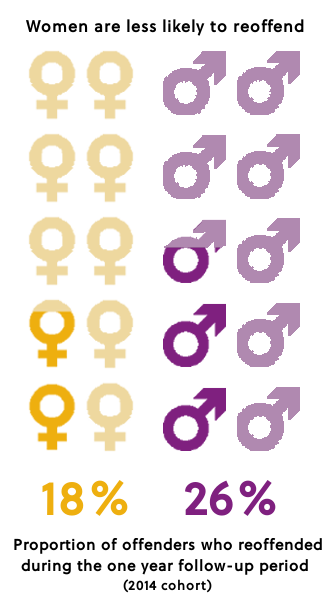
In 2014, 26% of male and 18% of female offenders reoffended during the one year follow-up period. Does it follow that harsher prison sentences lower reoffending rates?
According to a report by the Prison Reform Trust, short prison sentences are less effective than community sentences at reducing reoffending. This is because it was found that people serving prison sentences of less than 12 months had a reoffending rate seven percentage points higher than similar offenders serving a community sentence.
The report also finds that reoffending by all ex-prisoners costs the economy between £9.5bn and £13bn annually, with £7bn-£10bn of that coming from former short-sentenced prisoners.
So how can this figure be reduced? The key seems to lie with rehabilitation programmes, which we'll look at next.
To rehabilitate
Carefully delivered rehabilitation programmes prevent reoffending and could help former offenders get a new start into their lives after prison.
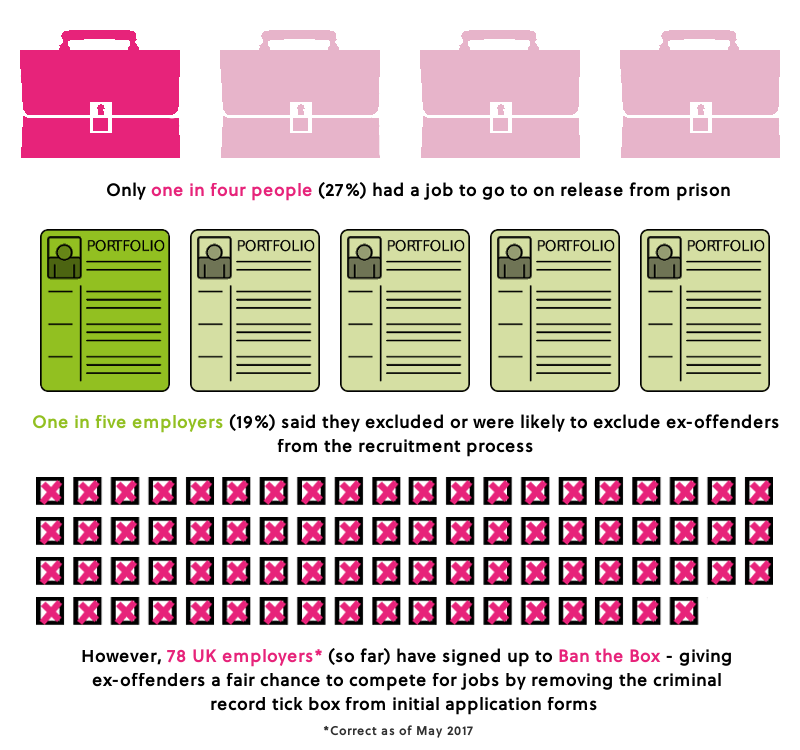
Finding a job after prison is a difficult task though: only one in four people had a job to go to on release from prison, and one in five employers said they excluded or were likely to exclude ex-offenders from the recruitment process.
But there are things that can be done to help prisoners gain a job and make them less likely to reoffend: a US study showed that prisoners who enrol in college/university classes have a 50% lower reoffending rate than prisoners who do not take any classes.
Apart from formal education, other programmes could benefit prisoners too. Recent research from the University of Oxford found that a 10-week yoga course improved prisoners’ mood, reduced their stress levels, and helped them perform better on a task related to behaviour control such as impulsivity and attention.
Another study using Scottish data found that the arts play an important role: learning to play music, for example, and then performing in front of audiences, encourages the improvement of verbal and written literacy skills. In addition, participants learned to work more effectively and developed self-confidence. All this together, the authors of the study argue, motivates prisoners to distance themselves from crime in the future.
So what’s the verdict?
Prisons are expensive but they serve an important role in society. While they protect the wider community as it stands at the moment, it appears that more needs to be done to keep both prisoners and guards safe. One cost-effective option could be rehabilitation programmes: they engage prisoners, help them learn new skills, and make them less likely to re-offend. Setting up these programmes costs money initially, but by decreasing reoffending rates prison populations could be reduced, saving costs in the long-term. Educational programmes could also help former offenders get a job, thereby making them contributors to society and boosting the economy.
So what do you think? Can you think of any alternatives to the current prison system?
The setup
So imagine that there are two suspects - let's call them Alice and Bob - and they have been arrested and imprisoned for a minor offence. Let's say, for trespassing on private property. The police suspect that, in addition to the minor offence, Alice and Bob committed a more serious crime: they stole some goods. However, the police do not have sufficient evidence to convict Alice and Bob of theft. Alice and Bob are held in separate prison cells and are interrogated with no means of communicating with each other. The police offer each of them a deal: If you confess to theft and your partner denies the crime, you will be released and your partner will be sentenced to three years in prison. If both of you confess, then you will each be convicted of theft and be sentenced to two years in prison. If you both deny the theft, you will each be sentenced to one year in prison for trespassing.
Now, we assume that Alice and Bob will each choose to confess or deny solely based on their own self-interest and that they have neither loyalty to each other nor the opportunity to punish or reward the other one for their decision.
In the language of Game Theory, this setup is called a non-cooperative game, and Alice and Bob are called players. The game is non-cooperative because we assume that the players are purely rational and self-interested and do not have to worry about their decision affecting future interactions.
The solution
So Alice and Bob can each do one of two things: confess to the theft or deny it. We can summarize the possible outcomes in the following table:
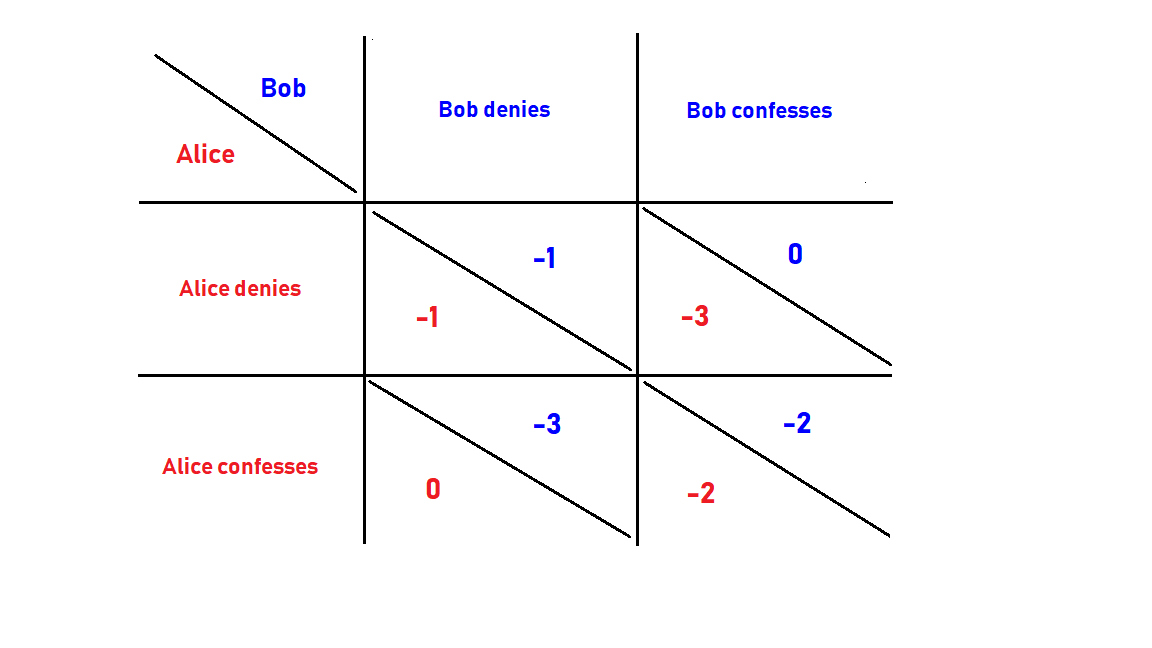
In Game Theory this table is called a pay-off matrix and it can help to predict the outcome of the game.
Looking at this table we can see that, in order to minimize the total number of years spent in prison, both Alice and Bob should deny the theft. However, if we consider the problem from Alice's and Bob's perspectives individually, we can see why they would choose to confess, betraying each other.
From Alice's perspective, if she thinks that Bob will deny the theft, then she should confess, so that she will be released. If she thinks that Bob will betray her and confess, then she should definitely confess, since two years in prison is better than three. Bob is in the exact same position: He should confess if Alice denies the theft, and he should also confess if she confesses.
Confessing results in a better pay-off for Alice, regardless of Bob's decision and vice versa. Hence, confessing is the dominant strategy for each of them.
The dilemma is that cooperating would have led to a better outcome - not only for the pair as a whole, but also for each of them individually - but each of them could always gain by betraying the other. In game theoretical terms, one says that the globally optimal solution - both Alice and Bob denying the theft - is unstable. The non-cooperative outcome of the game - both Alice and Bob confessing to the theft - is an example of a Nash equilibrium, named after the American mathematician John Forbes Nash Jr.
Real-world applications
Now, for most of us the prison setting is not a scenario that we'll personally encounter. There are however many examples in everyday life that follow the same principle.
One example from economics concerns marketing of a product.
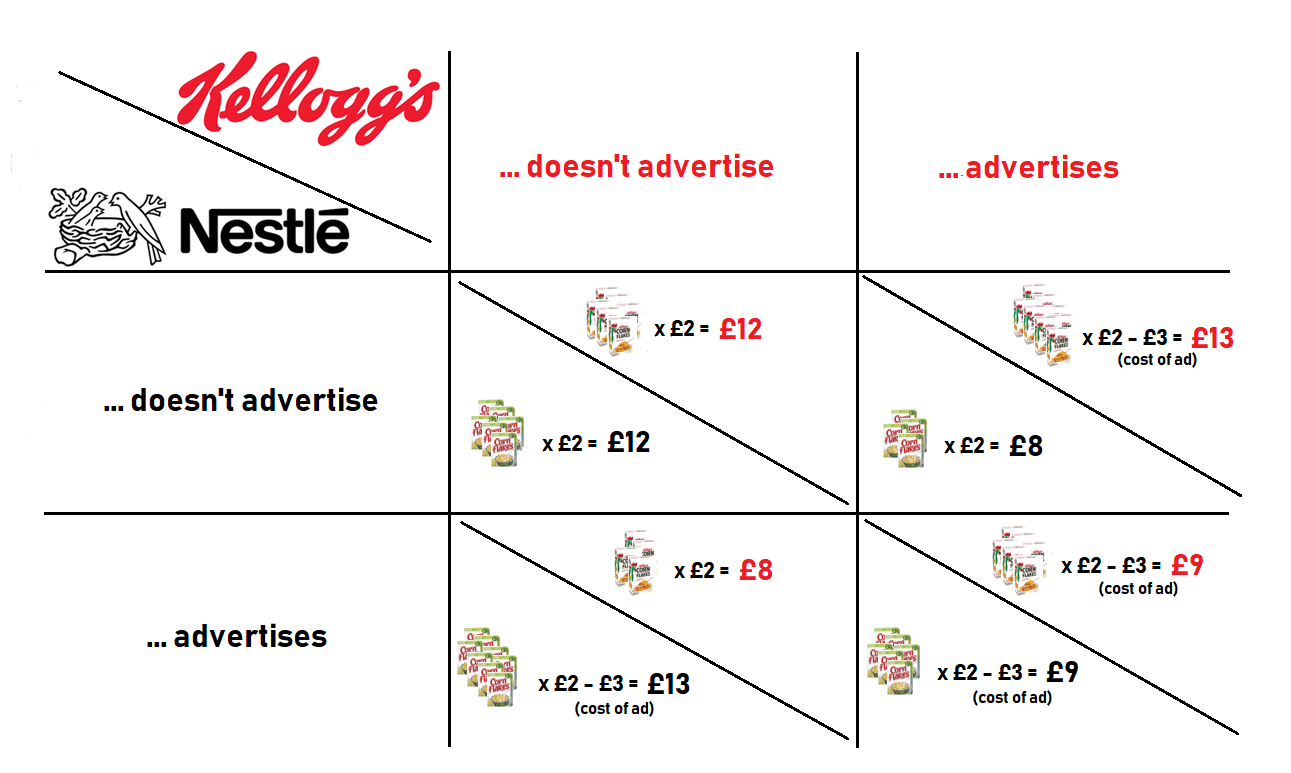
Consider two companies that make identical products. To be concrete, let's take two competing cereal manufacturing companies that produce identical cornflakes: Kellogg's and Nestlé.
Both companies need to decide how much money they spend on advertising. Since the products they make are the same, advertising will have a huge impact on sales.
For simplicity, let's assume that there are no other cornflakes brands on the market and that Kellogg's and Nestlé each have only two options to go about their cornflakes marketing: to advertise or not to advertise.
If neither company advertises, consumers will pick cereal boxes randomly: roughly half of them will buy Kellogg's and the other half will buy Nestlé. Kellogg's and Nestlé will end up sharing the profit margin for cornflakes.
Now if Kellogg's chooses not to advertise, then Nestlé will benefit greatly from advertising. If Nestlé is the only one to advertise, then its profit will increase, outweighing the cost of advertising, while Kellogg's will lose profit.
If both Kellogg's and Nestlé advertise, then the effect of advertising cancels out: consumers will choose cornflakes boxes at random. The two companies share the profit margin roughly equally, but they are left with the cost of advertising, putting them both in a worse position.
Although the optimal solution would be for neither company to advertise their cornflakes, individually, each company sees that they can always make more money by advertising. Both Kellogg's and Nestlé advertising is the Nash equilibrium in this scenario and is the likely outcome if we assume non-cooperative behaviour from both companies.