A woman’s rule
The 1800s were a period of massive change and although people living in the UK at that time might not have talked about the word “gender”, being a woman or being a man definitely made a difference to how people behaved and were treated.
Queen Victoria was on the throne for most of the 19th century from 1837 to 1901. With a woman ruling England, maybe you’d expect that she was a role model for others and that more women would be able to go to work or take up positions of power? But that wasn’t the case.
That said, Queen Victoria’s position did sometimes give weight to women’s campaigning on certain subjects. “You quite often see women petitioning the Queen on particular causes like anti-slavery,” says Professor Gleadle.
She explains that at that time it was frequently expected that women would be more compassionate than men. Women could exploit this to claim their right to speak to a female monarch about certain national questions. For example, women might have reasoned, “If slavery is a moral evil, it’s wrong, and if women are supposedly the more moral sex, then surely there is a duty upon us to speak and to act on these questions.”
This may seem pretty old-fashioned when compared to modern ideas in the UK, but it was similar in other areas of life too. For example, there were developments in medicine, such as the growth in specialisms devoted to women’s health (like obstetrics and gynaecology). Nonetheless, there were still some very conservative ideas about how women’s bodies worked and how they should behave.
“Many of these new obstetric specialists claimed the womb was the cause of women’s problems, making women susceptible to what they would call “nervous diseases” including hysteria and weakness,” says Professor Gleadle.
School and work
However, a key area of progress was education. Girls were increasingly getting the chance to stay on at school and attend university. And although you might expect women in the 19th century to stay at home and take care of their family, that wasn’t always the case. Even though until 1870 the law said that a woman’s property became her husband’s when they got married, in practice that didn’t always happen.
“Just looking at what the law said doesn’t take into account the reality of individual relationships. There might be some give and take between men and women,” says Professor Gleadle. “We know that in real-life men and women sometimes ignored the law.”
Women of all backgrounds went to work. Historians have found lots of women running businesses as well as working in factories, shops and other industries. However, Professor Gleadle points out that towards the end of the century, when working men’s wages had improved, working-class women frequently opted to stay at home. In some ways, they faced the same choices that some women do today.
“Increasingly upper working-class women were starting to wonder whether it was actually worth going to work economically, because by the time they had paid for someone to mind the children, do the washing, getting the food prepared, they weren't actually gaining as much as they might have hoped,” she explains. “Many women felt that the best way to protect family life was to have more time in the home to make it a more pleasant space for everybody.”
Professor Gleadle suggests that although there were certainly differences between men and women and their lives in the 19th century, it is also very important to look at the differences between women themselves. More well-off women were able to get a secondary education and take up good jobs in offices, whereas poorer women had more limited opportunities.
Also, it is well known that women were not able to vote in parliamentary elections in the 19th century, but single women who were the head of their household were able to vote in many local elections. Some women did begin to campaign for females’ right to vote in national elections, but during the early part of the century, many working-class women prioritised campaigning for men to have the vote. These activists believed that if one person in their family could have a say at election time it would benefit everyone. “Working-class women might have felt that this was a rational strategy,” says Professor Gleadle.
Slow changes with a big impact
Opportunities for women continued to expand in the 20th century - although the changes were not always straightforward. Professor Gleadle says that women carried out jobs traditionally done by men during the First World War (1914-1918).
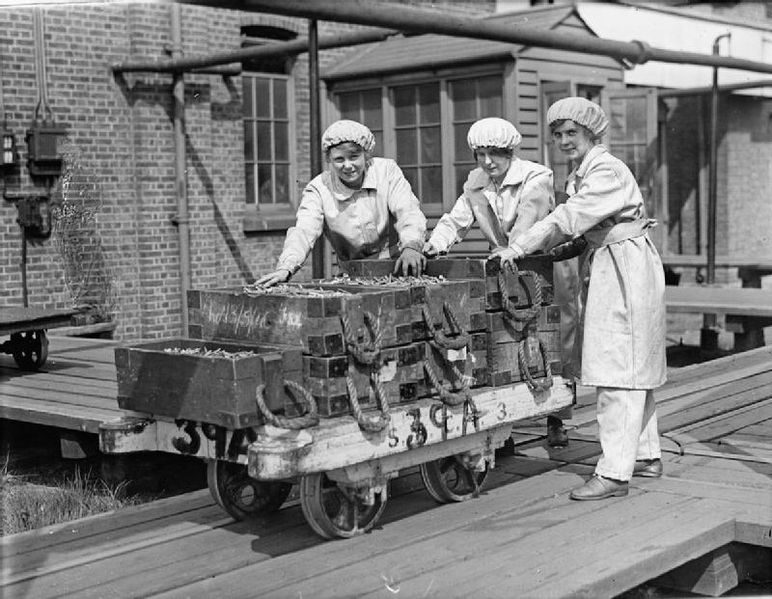
Image credit: (Q 27881) the Imperial War Museums collections. Public domain.

However, “there were very careful negotiations between trade unions and the government in wartime about the conditions upon which the women could take up those jobs. When men came back, women were removed from those jobs on the whole,” she says.
What Professor Gleadle thinks makes the most fundamental impact upon women's position isn’t necessarily the big ‘headline’ events, but rather the combined impact of many smaller shifts.
“Accumulation of changes really makes the difference,” she says. “If we have a law that sets a certain standard of expectation of behaviour, for that to make a difference to women’s lives, there have to be cultural changes as well.
“The obvious change - which affected men as well as women - was the gradual advent of free universal education. Unless you have a state that is providing free education for everybody, things like the vote are not going to have the impact that you might want because people are not going to be able to take advantage of that opportunity.”
When thinking about our Big Question, Professor Gleadle thinks that gender is still very important today.
“As we’re still in a situation where the gender pay gap is stark, where there is such rife sexual discrimination and sexual harassment, [then] the way in which society is constructing gender roles means that it definitely matters to people’s lives,” she says.
So what do you think? Does your gender make a difference in how you’re treated at school or at home? What about if you’re looking for a job?
If you would like to learn more about the international history of gender and sexuality both past and present, take a look at the history blog NOTCHES.

In 2017, UK department store, John Lewis removed ‘boys’ and ‘girls’ labels from its children’s clothing to prevent gender stereotyping. Do you think this is a good idea?
What is a meme?
The word ‘meme’ is a shortened version of the Ancient Greek word ‘mimeme’, which means imitated thing. It was later used by Prof. Richard Dawkins as a way to explain how ideas and cultural behaviours spread with reference to his work in evolutionary science. Whilst Dawkins was originally referring to parts of culture, like fashion or cinema, the word ‘meme’ was adopted to refer to content on the internet as he explains in the video below:
https://www.youtube.com/watch?v=xCzb6SuyriU
When thinking about their use online, a meme can further be defined as ‘an image, video, piece of text, etc., typically humorous in nature which is copied and spread rapidly by internet users’ (source).
As a form of communication, memes involve four key elements:
• They have a central message which is understood by a community.
• They change over time and are remixed by the community who embrace them.
• They have a format which can be easily adapted and remixed.
• They go viral meaning they are viewed and shared by many users online and often across different websites.
Memes and gender
Siân Brooke is a doctoral researcher at the Oxford Internet Institute. She is particularly interested in how gender is represented in online spaces such as forums where users’ real-life identities are hidden and they may take on fictional names (pseudonyms) and personalities. This is known as the pseudonymous web.
As part of her research, Siân analysed the way gender was represented in discussion threads on Reddit. Reddit is a news sharing and discussion website which has around 330 million active users, about the same size as Twitter. Sian studied how the discussion evolved over a 6-month period through the use of memes and user commenting.
In the study, Siân found that there was an uneven distribution of power in the way gender was represented in the memes shared. For example, the male characters in the memes could legitimately express positive or negative behaviour (e.g. drug taking, being disrespectful) in a range of ways, gaining support from the other users in the process. On the other hand, the female characters shown did not have the same freedoms and there was a large emphasis on their appearance, sexual availability and (over)dependence on men. The female characters were often subjected to what’s known as the ‘male gaze’. This term and idea was first created by film theorist Laura Mulvey to refer to when are women objectified in films and other media, and are viewed from the perspective of a heterosexual (straight) man.
Siân observed some positive representations of feminism (a social movement that aims to gain equality for all genders) in the memes in the discussion. Interestingly, these tended to include a male central character. Plus, there were several aspects in their design which compromised their message of promoting gender equality.
Let’s take the meme below as an example, which includes an image of actor Ryan Gosling and a reference to the work of philosopher, Jacques Derrida.
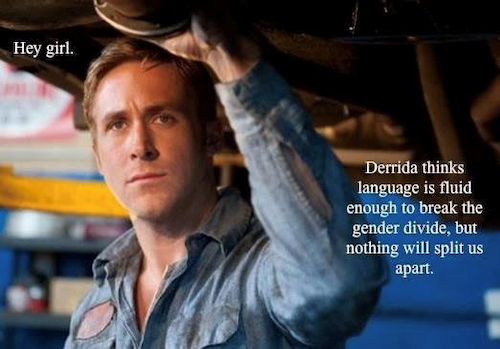
irstly, the use of the phrase ‘Hey girl’ suggests lower female status level since the word ‘girl’ is traditionally used to refer to a female child. Think about if we called grown men “boys” the same way we refer to grown women as “girls”, this would could seem rude and patronising.
Secondly, there is a contradiction between the message of gender empowerment with ‘break the gender divide’ and that of gender dependence in the statement, ‘nothing will split us apart’. The latter also hints at heterosexual norms of desire and being romantic, which further questions the authenticity of the message of gender fluidity (i.e. the thinking that gender behaviours are not necessarily fixed or tied to physical sex characteristics) (source).
In contrast, memes which showed female feminists displayed images whereby the central character was angry and the supporting caption was hypocritical in what it said.
And so Siân challenges the equality of participation in pseudonymous online spaces. Far from inviting openness, the memes and commenting in the discussion she studied tended to reinforce gender stereotypes, rather than question them. The community’s collective understandings were often presented by a central male character and casual sexism was often disguised and legitimised with humour.
Does gender matter?
Siân explains that the reason why gender matters in online discussion threads like the ones she studied, is because everyone is anonymous. You can’t tell who you are talking to, and even who is participating in discussions. Because everyone is sharing images of men as desirable and women as just someone to be pretty and sexually available it makes it seem as if everyone on the website is a heterosexual man. Therefore, you might not see anybody like you or you might dislike the way the women are talked about in the memes. You may feel like you do not belong there. In addition, the way that gender stereotypes are shown in memes can affect how you think about gender offline with your friends and family.
Sian’s research shows that it’s important to think about how we present ourselves and other people even when we'are online and nobody knows who we are.